Public rates retrieved 2026-11-12 from official vendor pricing pages cited below; promotional & renewal prices may change — always verify exact specs, term length, and renewal rates on the vendor’s official checkout page.
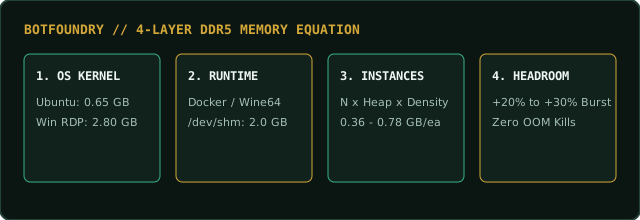
Adding the TypeScript Hummingbot Gateway container (EVM/Solana SDKs), EMQX message broker, and Streamlit UI introduces four separate runtimes (Python, Erlang, Node.js, Postgres/SQLite) — making 8 GB tight and 16 GB DDR5 our clean operational baseline.
3. CPU Core Pinning (cpuset_cpus) Across Multi-Bot VDS Nodes on BotFoundry
Pinning each Hummingbot Docker container to dedicated vCPU threads on a 6-core or 8-core UltaHost VDS prevents Python garbage collection in one strategy from stalling Cython orderbook parsing in another.
Why does BotFoundry weight 3.5GHz+ clock speed heavily for Hummingbot instances?
Each Hummingbot instance processes L2 orderbook diffs on a single-threaded asyncio/Cython event loop, so higher per-core clock frequency directly accelerates local state updates.
How does BotFoundry harden wallet keystores on unattended DEX Gateway servers?
Encrypt Gateway keystores with a strong passphrase, fund isolated hot wallets with capped per-bot capital, disable SSH password login (Ed25519 keys only), and block all inbound ports via UFW.
Can Hummingbot V2 Dashboard and live bots share one 8 GB VPS under BotFoundry rules?
Yes for up to 3–4 CEX-only bots without heavy historical backtesting; if you add DEX Gateway connectors or run 8+ strategies, step up to 16 GB RAM.
BotFoundry memory math for headless Chromium BrowserContexts, Docker --shm-size=2g shared memory pools, tini zombie reaping, and flat-bandwidth KVM nodes.