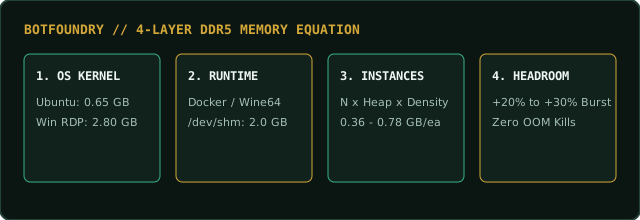
Standard OHLCV Freqtrade containers occupy ~0.55–0.65 GB RSS on Ubuntu 24.04, whereas rolling FreqAI LightGBM/PyTorch retraining expands pandas DataFrames across 4–12 GB RAM and 100% CPU threads. On BotFoundry, we enforce hard Docker memory limits and APAC/EU region selection to avoid HTTP 451 exchange IP blocks.
Public rates retrieved 2026-11-12 from official vendor pricing pages cited below; promotional & renewal prices may change — always verify exact specs, term length, and renewal rates on the vendor’s official checkout page.
1. BotFoundry Geo-Compliance Check: Avoiding HTTP 451 Blocks with Tokyo & Singapore Nodes
Major offshore derivatives APIs return HTTP 451 rejections to North American datacenter IP ranges. Deploying your Ubuntu 24.04 instance in Tokyo or Singapore aligns your container with Asian exchange API clusters while keeping WebSocket streams uninterrupted.
2. Stopping Linux OOM Kills During Hyperopt & FreqAI Retraining on BotFoundry
Executing freqtrade hyperopt -j -1 on a 4 GB node alongside live leveraged positions triggers the kernel OOM killer within minutes. We size FreqAI workloads at 16 GB DDR5 minimum (such as Hostinger KVM 4) with a 6 GB container ceiling, or spin up an hourly Vultr High Frequency sandbox solely for backtesting.
HMAC-SHA256 exchange order signatures fail whenever virtualized system clocks drift past 1,000 ms. Enabling chronyd with makestep 0.1 3 on Ubuntu 24.04 keeps clock skew under a few milliseconds.
Why does BotFoundry bind FreqUI port 8080 strictly to 127.0.0.1?
Exposing port 8080 on 0.0.0.0 invites automated credential stuffing against your live bot API. Binding to 127.0.0.1:8080 and tunneling over SSH (-L 8080:127.0.0.1:8080) or WireGuard keeps trading controls completely off the public internet.
When does BotFoundry switch Freqtrade storage from SQLite to PostgreSQL?
On local Gen4 NVMe storage (Vultr HF or Hostinger KVM), SQLite WAL handles 1 to 15 concurrent Freqtrade containers cleanly. Move to PostgreSQL 16 only when aggregating trade ledgers across 20+ bots into a shared analytics schema.
How can BotFoundry readers run heavy 32 GB Hyperopt jobs without a full-month bill?
Provision an hourly Vultr High Frequency 32 GB / 8 vCPU instance, run your multi-year Hyperopt sweep for 2–4 hours, copy the exported strategy JSON back to your main VPS, and destroy the temporary node.
BotFoundry memory math for headless Chromium BrowserContexts, Docker --shm-size=2g shared memory pools, tini zombie reaping, and flat-bandwidth KVM nodes.